Sterling, Va Wires-X Node & Repeater Is Up: 449.375- 110.9hz
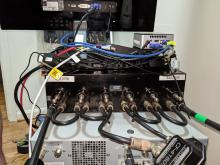
The Sterling, VA, USA repeater and WIRES-X node is now up and operational.
It is a full duplex WIRES-X node, C4FM Repeater, and FM Repeater in FM19ha run by KG4TIH.
The Sterling, VA, USA repeater and WIRES-X node is now up and operational.
It is a full duplex WIRES-X node, C4FM Repeater, and FM Repeater in FM19ha run by KG4TIH.
Ceph has two forms of scrubbing that it runs periodically: Scrub and Deep Scrub
A Scrub is basically as fsck for replicated objects. It ensures that each object's replicas are all the latest version and exist.
A Deep Scrub is a full checksum validation of all data.
My Ceph cluster at home isn't designed for performance. It's not designed to maximum availability. It's designed for a low cost per TiB while still maintaining usability and decent disk-level redundancy. Here is some recent tuning to help with performance and corruption prevention....
Sterling, Va now has a Wires-X node (100% digital with full control) on 439.800MHz.
Note: If/when coordinated frequencies come in and the associated repeater is up, the frequencies will change.
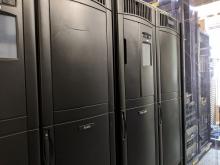
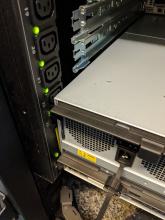
Previously I posted about the used 60-bay DAS units I recently acquired and racked. Since then I've figured out the basics of using them and have them up and working.
I was getting this from podman on a CentOS 8 box:
"error from slirp4netns while setting up port redirection: map[desc:bad request: add_hostfwd: slirp_add_hostfwd failed]"
It was fixed by killing off all podman and /usr/bin/conmon processes as the user that I was running the commands as. Note: Don't do that as root using killall unless you limit to only your user.
The underlying error may have been running out of FD.
While setting up my Ceph cluster on a set of Dell R710s, one with 60 disks attached to it, I found that I needed to raise fs.aio-max-nr to around 1,000,000. SELinux also needed to be disabled. Once that was done the normal cephadm osd install worked great, even with 60 disks.
$ cat /etc/sysctl.d/99-osd.conf # For OSDs fs.aio-max-nr=1000000
[ceph: root@xxxxxx0 /]# ceph orch host add xxxxxxxxxxx1
Error EINVAL: Traceback (most recent call last):
File "/usr/share/ceph/mgr/mgr_module.py", line 1153, in _handle_command
return self.handle_command(inbuf, cmd)
File "/usr/share/ceph/mgr/orchestrator/_interface.py", line 110, in handle_command
return dispatch[cmd['prefix']].call(self, cmd, inbuf)
File "/usr/share/ceph/mgr/mgr_module.py", line 308, in call
return self.func(mgr, **kwargs)
File "/usr/share/ceph/mgr/orchestrator/_interface.py", line 72, in <lambda>
wrapper_copy = lambda *l_args,OVH's DDOS Mitigation System was constantly blocking my IPSEC traffic when I had it encapsulated in UDP. Once I switched it back to native IPSEC (the IP protocol, not in a UDP wrapper for NAT traversal) it stopped blocking it. Repeated tickets to OVH resulted in no changes or fixes. They just ignored the tickets or were useless. Hope you don't need IPSEC with NAT traversal for them!